

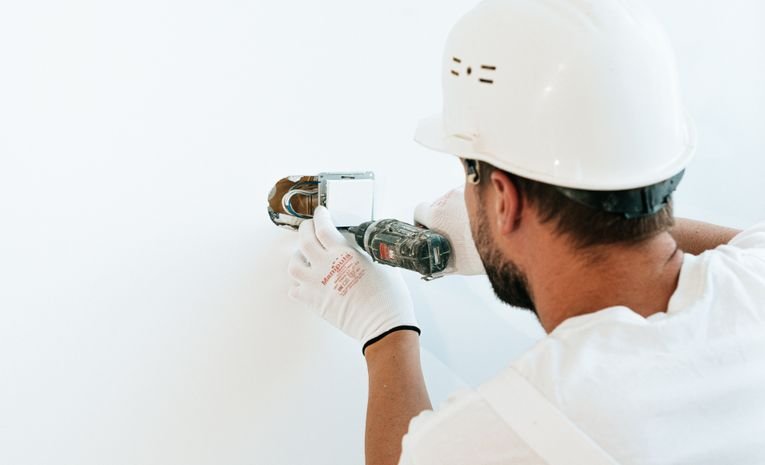
Quick answer: Run a wire or stud detector over the area first to check for hidden pipes or cables. For small holes under 5cm, fill directly with filler. For medium holes, stick a self-adhesive mesh patch over the hole and cover with joint compound. For large holes, cut a neat square, fix a timber batten inside for the patch to screw into, then tape, fill, sand, and paint.
A hole in plasterboard, whether from an accidental knock, a door handle, or removing an old fixing, looks worse than it actually is to fix. The right method depends almost entirely on size, so working out which category your hole falls into is the first and most important step.
Safety First: Check Before You Cut
Before doing anything else, run a wire and stud detector over the damaged area and the surrounding wall. This confirms there are no hidden pipes, cables, or metal fixtures behind the plasterboard that could be disturbed or damaged during the repair.
What You Will Need
- Wire and stud detector
- Filler or joint compound (such as Polyfilla or EasiFill)
- Self-adhesive mesh patch, for medium holes
- A spare piece of plasterboard, for large holes
- Scrim tape (fibreglass drywall mesh tape)
- A timber batten or scrap of wood, for large holes
- A putty knife, sandpaper (around 180 grit), and matching paint
Small Holes (Under 5cm)
These are typically nail holes, small dents, or picture hook marks.
- Clean the hole and surrounding area of loose plaster, dust, and debris.
- Apply filler directly into the hole with a putty knife, pressing it in firmly so there are no air gaps.
- Smooth the filler level with the surrounding wall surface.
- Once fully dry, lightly sand the area smooth.
- Prime if needed and paint to match the surrounding wall.
Medium Holes (5cm to 10cm)
Typically caused by a door handle impact or a removed fixture, these need a bit more support than filler alone can provide.
- Trim any loose or torn paper edges around the hole and clean away dust.
- Peel the backing off a self-adhesive mesh patch and centre it directly over the hole.
- Spread joint compound over the patch with a putty knife, feathering the edges outward so the repair blends into the surrounding wall.
- Allow it to dry fully, then sand smooth. A second thin coat, left to dry and sanded again, gives the best finish.
- Prime and paint to match once the surface is smooth and dry.
Large Holes (Over 10cm)
Larger holes need a solid backing to support a proper plasterboard patch, since filler or a mesh patch alone will not hold.
- Trim the hole into a neat square or rectangle, which makes fitting a patch far easier and neater than trying to match an irregular shape.
- Cut a piece of timber batten slightly longer than the width of the hole.
- Insert the batten behind the plasterboard through the hole and screw it into place from the front, securing it to the solid plasterboard on either side of the hole.
- Cut a plasterboard patch to match the size of the hole and screw it into the timber batten.
- Apply scrim tape over all the joins between the patch and the surrounding wall.
- Cover the taped joins with joint compound, feathering the edges as before.
- Once dry, sand smooth, apply a second coat if needed, then sand again before priming and painting.
An Alternative Method for Larger Holes
If you cannot access behind the wall to fit a timber batten, an alternative is to cut a patch of plasterboard slightly larger than the hole, drill a small hole through its centre, and thread a screw through it to act as a handle. Apply strong construction adhesive to the back edges of the patch, feed it into the hole at an angle, and use the screw to hold and position it flush against the inside back face of the wall while the adhesive sets. Once set, the screw can be removed or pushed into the void, and you finish with scrim tape and filler as with the timber batten method.
Repairing Holes in Hollow Doors
The same principles used for plasterboard walls apply almost exactly to hollow internal doors, which are damaged in a similar way. Square off the hole, fit a backing patch, and fill and sand as you would for a plasterboard wall repair.
Fixing Something to the Wall Afterwards
If you plan to rehang a shelf, mirror, or picture in the repaired area, avoid relying on standard plasterboard fixings alone for anything with real weight. Use a spring toggle or hollow wall anchor for moderate loads, since these grip the back of the board rather than just the surface layer. For anything heavy, it is worth locating and fixing into a solid stud or the timber batten from your repair instead, since this gives a far stronger and more reliable fixing than the plasterboard alone can support.
Preventing Future Damage
- Fit door stops to prevent handles repeatedly hitting the same spot on the wall.
- Consider protective corner guards in high-traffic areas prone to knocks, such as narrow hallways.
- Use appropriate wall fixings for hanging items in the first place, rather than overloading a standard plasterboard fixing.
Related Guides
Frequently Asked Questions
How do I fix a large hole in plasterboard without it falling through?
Fit a timber batten behind the hole first, screwed into the solid plasterboard on either side, then screw a plasterboard patch into the batten. This gives the patch something solid to hold onto rather than relying on filler alone.
What is scrim tape used for in plasterboard repair?
Scrim tape, a fibreglass mesh tape, covers the joins between a patch and the surrounding wall, giving the filler or joint compound something to grip and helping prevent cracks appearing along the repair line later.
Can I fix a plasterboard hole without cutting it bigger first?
For small holes under about 5cm, yes, filler alone is usually enough. For medium and large holes, squaring off the edges first actually makes for a neater, more stable repair than trying to patch an irregular shape.
What fixing should I use to hang something heavy after a plasterboard repair?
A spring toggle or hollow wall anchor works for moderate loads. For anything genuinely heavy, fix into a solid stud or the timber batten used in the repair rather than relying on the plasterboard alone.
Final Thoughts
Matching your repair method to the size of the hole is the key to a lasting fix, from a simple filler job for small dents through to a timber-backed patch for anything larger. Take the time to check for hidden wiring first, and a bit of patience with sanding and a second coat of filler will give you a repair that disappears into the wall rather than standing out.